
Shifting Sands: Michigan's Critical Dune Areas
Provided by: Michigan Department of Environment, Great Lakes, and Energy (EGLE)|Published on: December 12, 2024|Last updated: July 16, 2026
Grades: 9, 10, 11, 12
Type: Articles/Websites
Subjects: Earth and Space Sciences, Geography
Authors: EGLE
Location: North America > United States > Michigan

This resource has been reviewed by SubjectToClimate's climate scientists and verified for scientific accuracy and up-to-date information. Learn about our review process →
This resource has been reviewed by SubjectToClimate's climate scientists and verified for scientific accuracy and up-to-date information. Learn about our review process →
Synopsis
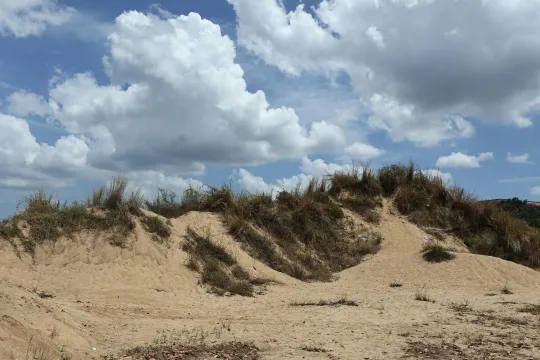
- In this animated and interactive article, students will read about the importance of the sand dunes in Michigan along Lake Michigan and Lake Superior, and how they are being protected.
- Students will learn about the native plant and animal species that depend on these sand dune habitats, shoreline management strategies, and the government efforts to protect them.
Teaching Materials
Positives
- The interactive map, before and after slide-bar images, and colorful images are engaging features of this resource.
- A link button pops up when hovering over a heading to help teachers assign just one section of the reading.
Prerequisites
- Some students may need the terms dune, erosion, shoreline armoring, and others defined before reading this article.
Differentiation & Implementation
- Before introducing the article, teachers can ask students to recount their experience with sand dunes.
- Connect this resource to climate change topics by discussing how the dunes may be affected by changing weather patterns and more extreme storms, or how the dune species in Michigan are adapting to their changing climate.
- To make geography connections, students can analyze the maps from the Atlas of Critical Dunes.
- Students can form research groups to learn more about one of the critical or imperiled natural communities mentioned in the reading.
- Alternatively, students can choose to research one of the endangered or threatened species listed in the reading.
- After reading the article, students can create posters to inform others about things they can do to protect critical dune areas.
This article emphasizes the importance of dunes for the local ecosystem and how disrupting the dunes and their natural life cycle causes problems for humans and the environment. This resource can be used as an excellent example of how humans can have a big impact on the environment and how humans live and act in a way that protects and conserves the environment, while also enjoying it. The information presented is accurate, and this resource is recommended for teaching.
Teaching Tips
Standards
Resource Type and Format
Scientist Reviewed
This resource has been reviewed by SubjectToClimate's climate scientists and verified for scientific accuracy and up-to-date information. Our review process ensures that every resource in our library reflects the current state of climate science.
Learn about our review process →